


How Social Media Shapes Veteran and First Responder Opinions
Tactical Transition Tips: Filtering Noise to Prepare for Life After Service
If you’re paying attention, it probably feels like everywhere you look, there’s another warning about what comes next. Another post, another clip, another headline telling you bad things are, how broken the system is, or the bitterness “our people” have once they step away. The volume alone makes it feel normal, like this must be the norm. It isn’t.
What you’re seeing isn’t a clean snapshot of reality. It’s a filtered environment built around attention. News outlets, organizations, and individual creators all operate under the same pressure. Content that provokes fear, anger, or resentment keeps people watching, clicking, and commenting. Calm, balanced, and positive information doesn’t do that nearly as well, if at all. So, it gets buried. Not because it’s wrong, but because it doesn’t perform.
That matters more than most people want to admit, especially when you’re thinking about your own transition. The stories you absorb don’t just inform you. They shape expectations. They influence how confident you feel, what risks you think are waiting, and how defensive or open you become before anything has even happened. When you feed is saturated with frustration, it subtly teaches you that bitterness is inevitable and that someone else is always to blame.
There’s another uncomfortable component to this. What shows up next in your feed isn’t random. What you watch, what you linger on, and what you interact with trains the system. Platforms feed us more of what keeps us engaged, not what keeps us grounded. And some of the loudest voices understand that all too well. They lean into negativity because it draws attention. They inflame because it converts to clicks, likes, and shares. Accuracy and balance don’t always keep us on a site or help the creators grow, so it isn’t prioritized.
Transition is disruptive. Identity shifts are hard. But there’s a difference between learning from real lessons and absorbing emotional residue that doesn’t belong to you. If you don’t slow down and recognize that difference, you can walk into your own transition carrying inaccurate expectations, bitterness, and bias that were built by someone else’s unresolved experience.
This isn’t about unplugging or pretending the noise doesn’t exist. It’s about realizing that the environment you’re consuming is shaping you, whether you intend it to or not. Once you recognize this, the question stops being who’s right or wrong and starts being what you’re allowing to influence how you prepare for what’s next.
While you continue reading this, give Round 106 a listen by clicking the Play button below.
LISTEN TO THE EPISODE
Close Range Group: Filter Voices by Outcomes, Not Volume
When you’re inside the one-year window, your margin for error shrinks fast. You don’t need fewer opinions, you actually need more, or at least better ones. The biggest threat right now isn’t that you don’t know enough. It’s that you’re listening to people who shouldn’t be shaping your thinking.
The loudest voices tend to sound confident. Some sound come across as angry. Some sound certain they’ve figured out what went wrong and who’s to blame. That volume creates a false sense of authority, especially when you’re under pressure and trying to make good decisions in a small window. But confidence and credibility aren’t the same thing. Neither are conviction and competence.
Filtering voices by outcomes means you stop asking how convincing someone sounds and start asking a simpler question. What does their life actually look like now?
Look past the tone and the storytelling. Pay attention to results. How are they post-service? Are they credible? Are they accountable? Are they building something that’s moving forward, even if it’s imperfect? Or are they replaying old personal conflicts, still circling the same frustrations, still living off their “used to be,” but not really offering anything of value other than more negativity about what you’re experiencing?
Whether you acknowledge it or not. Every story you absorb sets a reference point. Every warning you internalize shifts your expectations. If you spend your time listening to people who are still stuck, you don’t just learn from them. You start carrying their burden you’re your decisions that need clarity and momentum.
This isn’t about judging anyone else’s journey. Everyone’s transition story is different. Plenty of people struggle after transition, and some of that struggle is real. But some have difficult transition struggles because of their own actions and decisions, and struggle alone doesn’t qualify someone to guide you. Results do. Progress does. Taking ownership and having accountability does.
There’s another layer you need to be honest about. Some voices aren’t just impacted by their experiences. They’re performative. Negativity draws attention. Outrage pulls engagement. And when attention becomes the goal, accuracy and usefulness become optional. That kind of content isn’t designed to help you execute a transition. It’s designed to keep you watching, nodding, and reacting.
If you’re close to the exit, that’s a problem. You don’t have time to inherit someone else’s resentment. You don’t have time to let secondhand bitterness erode your confidence before you’ve even taken your first step. Execution requires belief that forward motion is possible. Constant exposure to failure and negativity narratives makes that harder, not because they’re always wrong, but because they’re rarely balanced.
Filtering by outcomes forces a different standard. You start gravitating toward people who talk less about how they were wronged, or victimized, and more about what they built. You notice who’s about learning instead of retelling. You pay attention to those who took responsibility early, even when the process was difficult and uncomfortable.
That shift changes how you interpret what you take in. Instead of absorbing every warning as a prediction, you start seeing patterns. You notice that people who planned, stayed disciplined, and kept their identity flexible tend to land on their feet. You also notice that the most vocal warnings often come from people who made decisions, avoided accountability, or they were treated unfairly based on their actions.
None of this requires you to ignore what you are ingesting. It requires you to put them in the right context and the right light. Learning from someone who’s navigated transition with structure and ownership prepares you to act. Putting more stock in someone who’s still beating the dead horse of their experience can prepare you to hesitate.
At this stage, hesitation is expensive.
You’re making real moves now. Applications. Conversations. Decisions that have timelines attached. The mental space you operate in will either support that work or quietly sabotage it. Filtering voices by outcomes is how you protect your focus without cutting yourself off from reality.
If someone’s content consistently leaves you more anxious, more cynical, or more defensive, pay attention to that signal. It doesn’t mean they’re lying. It means their experience might not be the lens you need right now. On the other hand, voices that emphasize preparation, accountability, and forward effort tend to leave you steadier, even when they’re honest about the difficulty.
That steadiness matters. Confidence in this phase doesn’t come from hype. It comes from alignment. From knowing you’re learning from people who’ve already walked through what you’re about to do and kept moving.
Volume will always be there. The negativity and the noise are easy to find. Outcomes take more effort to notice, but they’re the only filter that actually serves you when transition is no longer theoretical.
Right now, you don’t need to win arguments online or validate frustrations that aren’t yours. You need to stay grounded, execute cleanly, and move forward with intention. The voices you choose to listen to will either help you do that or make it harder than it needs to be.
WATCH THE EPISODE
Medium Range Group: Study Patterns, Not Complaints
If you’re sitting in the three to five year window, you have time. That time is an advantage, but it comes with a responsibility. What you choose to learn from now will quietly shape how prepared you actually are later.
At this stage, the risk isn’t panic or paralysis. It’s drift.
You’re far enough out that transition doesn’t feel urgent yet, but close enough that it’s already influencing how you think. That makes it easy to consume stories passively. You listen. You nod. You store them away as cautionary tales. Over time, though, something subtle happens. Complaints start to feel like explanations. Frustration starts to sound like inevitability.
That’s where people get misled.
Individual stories are compelling because they’re emotional and specific. They stick. But single stories rarely tell you, the whole story, or what actually matters for your future. They tell you what hurt someone else, not why their outcome unfolded the way it did. If you stay at that level, you miss the signal hiding underneath the noise.
Studying patterns means zooming out.
Instead of asking, “What went wrong for this person?” you start asking, “What keeps showing up across people who struggle?” When you do that honestly, the same themes surface again and again. People fall back to excuses because their actions and preparations impacted the ability to have a smooth transition. They tie their entire identity to the role because it’s what they have in the moment. They avoid building skills outside the organization because it’s uncomfortable or inconvenient. They assume loyalty will be repaid later, so they don’t prepare for alternatives.
Those patterns matter more than any individual complaint ever will.
This isn’t about dismissing frustration or pretending systems work perfectly. It’s about refusing to confuse explanation with excuse. Complaints can tell you something feels wrong. Patterns tell you what actually changes outcomes. If you only ingest grievances, you end up emotionally informed but practically unprepared.
That’s the slow corrosion risk.
Because you’re not under immediate pressure, it’s easy to believe you’re learning just by paying attention. But passive consumption isn’t preparation. It doesn’t build options. It doesn’t create leverage. And it doesn’t protect you if circumstances change faster than you expected.
Another trap shows up here too. Tribe capture.
When you repeatedly engage with the same type of content, you start absorbing the limited view that comes with it. Certain explanations become familiar. Certain villains feel obvious. Over time, that narrative can harden into identity. You don’t notice it happening because nothing feels urgent yet. But when transition gets closer, you realize you’ve internalized a story that limits how you see your options and how you interact beyond the uniform.
Studying patterns interrupts that.
You start noticing that people who handled transition well usually didn’t do anything flashy. They prepared quietly. They diversified skills early. They built relationships outside their immediate circle. They stayed realistic without becoming cynical. They treated transition as a process to manage, not a betrayal to react to.
However, you also start noticing that many of the loudest complaints come from people who made mistakes, but didn’t recover, people who expected clarity instead of creating it, and people who possibly weren’t the most optimal while they were serving, but now they want to tell you what optimum looks like. They didn’t plan long-term because they were engrossed in who they were then. Then, when it shortened, they were forced to move reactively. That’s not bad luck. It’s a pattern.
This is where time becomes either your greatest asset or your biggest liability. If you use these years to study outcomes instead of outrage, you gain perspective without bias. You can look at other people’s experiences as data instead of destiny.
That shift changes how you consume information. Instead of getting pulled into every emotional story, you start sorting. You ask what behaviors preceded the outcome. You pay attention to decisions made years earlier, not just the moment things unraveled. You learn what to replicate and what to avoid.
That’s how discernment develops.
At this stage, you don’t need certainty. Complaints are loud, but patterns are consistent. If you train yourself to see those patterns now, you avoid being surprised later. You also avoid drifting into the belief that outcomes are mostly determined by forces outside your control.
They aren’t.
The people who struggle most after transition often didn’t just face external challenges. They arrived unprepared because they assumed time alone would take care of things. It doesn’t. Time only helps if you use it intentionally.
Studying patterns keeps you honest. It forces you to confront uncomfortable truths early, when they’re still useful. It also protects you from adopting someone else’s bitterness as a stand-in for your own planning.
You don’t need to carry every story with you. You need to extract the lesson and move on. That discipline is what turns awareness into readiness.
You’re not supposed to have everything figured out yet. But you are supposed to be paying attention in the right way. The difference between those two things will decide whether your transition feels controlled or rushed when the calendar finally catches up.
Use the time you have to learn from outcomes, not complaints. It’s one of the few advantages this window gives you.
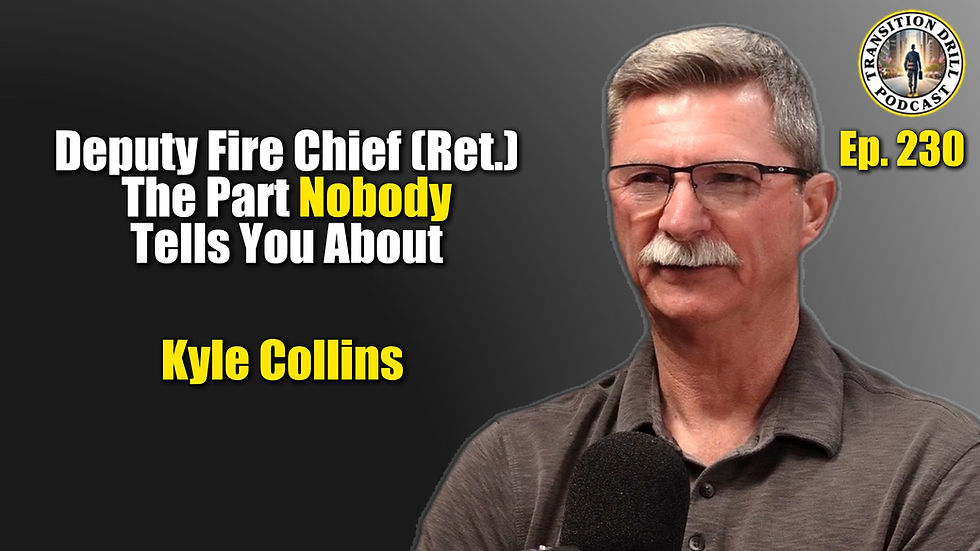
THIS WEEK'S GUEST INTERVIEW
Long Range Group: Build an Identity That Doesn’t Need an Enemy
When transition is still a distant concept, it’s easy to think there’s nothing to do yet. You’re early in your career and focused on becoming your best. That makes sense. But this is also the phase where the groundwork for future resentment or resilience gets laid, often without anyone realizing it at the time.
The people who struggle most after leaving don’t usually fall apart because they lost a job. They struggle because they lost the only version of themselves they ever invested in.
When identity is built almost entirely or, let’s be honest, completely around the uniform, it works well right up until it doesn’t. While you’re in it, the structure provides meaning, belonging, and purpose. But if nothing else exists alongside that identity, the moment it’s removed creates a vacuum. And vacuums tend to pull in explanations that make the loss easier to tolerate.
That’s where enemies show up.
For some people, leadership becomes the target. For others, the organization. For others, it’s civilians and society. Opposition gives identity something to push against when there’s nothing else to stand on. Over time, frustration hardens into a fixed view. Grievance becomes the through line that replaces purpose.
That process doesn’t start at transition. It starts years earlier, when identity gets narrowed instead of expanded.
Building an identity that doesn’t need an enemy means investing in who you are beyond your function. It’s not about disengaging from your role or being less committed. It’s about refusing to make one role carry the full weight of your sense of self. When you spread that weight across multiple domains, losing one doesn’t feel like losing everything.
This matters because long before you ever leave, the information environment is already shaping how people interpret identity loss. Content that frames frustration as betrayal and struggle as proof of systemic failure offers a ready-made explanation for discomfort. If that’s the only narrative you’ve absorbed, it becomes the default story when change eventually arrives.
But that story isn’t inevitable.
People who navigate transition with less bitterness usually had something else to anchor to long before it happened. Skills that were not only about the mission. Interests that existed outside the job. Relationships that weren’t defined by shared grievance. A sense of competence that didn’t disappear when the uniform came off.
Those things don’t appear overnight. They’re built slowly, while the career is still in progress.
This phase gives you the most leverage and the most freedom. You can explore without pressure. You can develop interests without needing them to pay off immediately. You can fail privately and adjust without consequences. That’s not a luxury you’ll have later on.
Identity diversification also changes how you consume information now. When your sense of self isn’t dependent on opposition, resentment narratives lose their pull. You can observe frustration without absorbing it. You can recognize real problems without needing to make them personal. You don’t need an enemy to explain who you are.
That internal stability becomes a buffer.
It protects you from adopting a belief that sees transition as loss rather than change. It keeps you from tying your future to the idea that something was taken from you instead of recognizing what’s still available to build. It also keeps you from turning every disappointment into evidence of betrayal.
People who never built that breadth often end up searching for meaning after the fact. That search is harder under pressure. When identity collapses all at once, resentment feels like clarity. It provides answers quickly, even if they’re limiting.
By contrast, when identity is layered, transition becomes an adjustment. Not easy, but manageable. You’re adapting, not reconstructing yourself from scratch. There’s less urgency to explain pain by assigning blame.
This isn’t about predicting when or how you’ll leave. It’s about acknowledging that no role lasts forever, even the ones you care deeply about. Preparing for that reality early doesn’t make you cynical. It makes you resilient.
If you use these years to build an identity that exists alongside your service instead of in opposition to it, you give yourself options later. You also reduce the likelihood that frustration will need a target when change eventually arrives.
Transition doesn’t create resentment on its own. Resentment and negativity grows when identity has nowhere else to land. The work you do now determines which path is more likely when the time comes.
Building an identity that doesn’t need an enemy isn’t about distancing yourself from your career. It’s about making sure that when it ends, you still recognize yourself.
Closing Thoughts
If there’s a common thread across all of this, it’s that what you take in shapes more than your opinions. It shapes how you expect things to unfold. It shapes how much control you believe you have. And over time, it shapes who you think you are allowed to become.
None of this requires you to stop paying attention or pretend that some people actually were victimized. It just asks you to slow down long enough to notice what you’re absorbing and why it keeps resonating. If certain narratives keep pulling you in, it’s worth asking what they’re confirming inside you, not just what they’re saying about the world.
The information environment isn’t neutral, but you aren’t powerless inside it. You still get to decide which voices influence your confidence, which stories shape your expectations, and which examples you treat as guidance instead of noise. That choice doesn’t happen once. It happens every time you scroll, listen, or linger.
Transition will challenge you no matter when it comes. What you carry into it will either make that challenge heavier or more manageable. Paying attention to what you consume now isn’t about control or restriction. It’s about awareness. And awareness, used well, has a way of quietly changing outcomes long before anyone else notices.
FIND MORE OF THE PODCAST EPISODES
 |  |  |  |
